
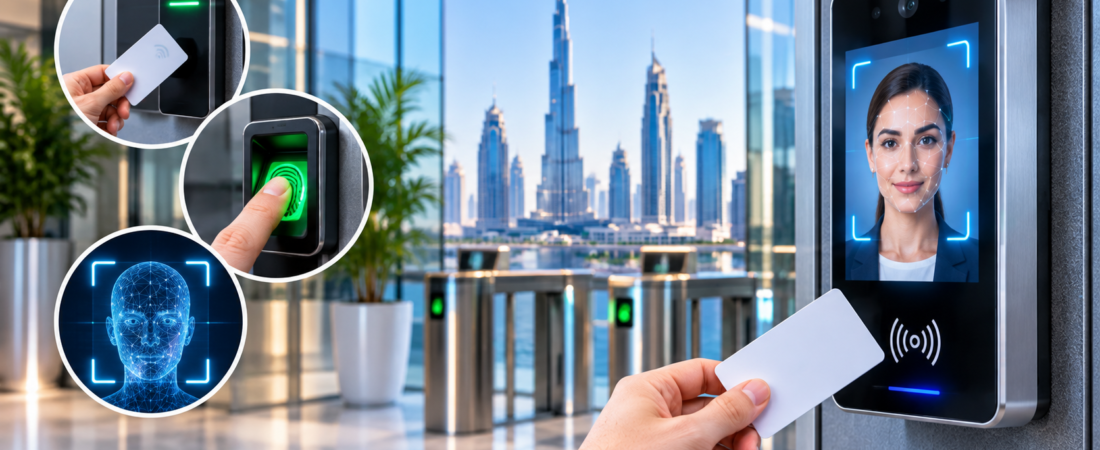
Dubai grows vertically, digitally, and quickly. Every new tower, business bay office, and mixed-use development must protect people, assets, and data from day one. Traditional locks and handwritten visitor logs no longer meet that standard. As a result, property owners now turn to Access Control Systems in Dubai to manage who enters, when they enter, and where they can go.
This guide explains the three most popular technologies: card readers, biometric scanners, and face recognition terminals. Moreover, it shows you how to compare them, which regulations matter, and how to choose the right solution for your building.
What Access Control Systems in Dubai Actually Do
An access control system verifies identity before it opens a door, turnstile, gate, or lift. The system checks each credential against a database of permissions. If the credential matches, the door unlocks. If not, the system denies entry and records the attempt.
Access Control Systems in Dubai typically include four core components:
- Credentials: cards, fingerprints, faces, PINs, or mobile passes
- Readers: devices that capture the credential
- Controllers: the “brain” that makes the unlock decision
- Management software: the dashboard that sets rules and stores logs
Furthermore, these systems do more than lock doors. They create a searchable audit trail, so security managers can see exactly who entered a server room at 2 a.m. That visibility helps with investigations, compliance checks, and daily operations.
Card-Based Access Control: The Reliable Workhorse
Card-based systems remain the most common entry point for businesses. Employees tap or swipe a proximity card, smart card, or key fob against a reader. The controller then checks the card number and unlocks the door within a second.
Cards offer several advantages. They cost less than other options, and administrators can issue, suspend, or replace them in minutes. In addition, most modern readers support encrypted formats such as MIFARE DESFire, which resist cloning far better than older 125 kHz proximity cards. For offices with a large workforce or frequent visitors, cards keep onboarding simple and affordable.
However, cards carry one clear weakness: people can lose, lend, or steal them. A card proves possession, not identity. Therefore, many Dubai companies pair card readers with PIN codes or cameras for sensitive areas. Cards still make an excellent choice for general entrances, parking barriers, and gyms inside residential towers.
Biometric Access Control: Your Body Becomes the Key
Biometric systems authenticate people through unique physical traits. Fingerprint scanners dominate this category, but palm vein, iris, and voice readers also exist. Because nobody can easily lend a fingerprint, biometrics deliver stronger identity assurance than cards.
Consider a data center, a financial trading floor, or a pharmacy storeroom. These spaces demand certainty about who walks through the door. Biometric readers eliminate “buddy punching” in attendance tracking, and they remove the cost of replacing lost credentials. Additionally, they integrate easily with payroll and HR platforms, which saves administrative hours.
Nevertheless, biometrics have limits. Dust, oil, or heavy manual labor can degrade fingerprint quality, so construction and industrial sites may see more failed reads. Hygiene concerns also lead some organizations to avoid touch-based scanners. Palm vein and iris technologies solve some of these problems, although they cost more. Consequently, you should test any biometric device in your actual environment before a full rollout.
Face Recognition: Hands-Free Entry for a Contactless City
Face recognition has become one of the fastest-growing options among Access Control Systems in Dubai. A camera captures a person’s face, converts it into a mathematical template, and matches it against stored profiles. The entire process often takes under a second, and users never need to touch anything.
This speed suits high-traffic locations such as corporate lobbies, co-working spaces, and residential towers. Employees simply walk up, look at the terminal, and enter. Many devices also include temperature screening, liveness detection, and mask recognition. Liveness detection matters especially, because it blocks attempts to fool the system with photos or videos.
Still, face recognition demands careful planning. Lighting, camera angle, and device quality directly affect accuracy. Moreover, facial data counts as sensitive personal information, so you must store and process it responsibly. When you deploy it correctly, though, face recognition offers an outstanding blend of convenience, speed, and security.
Card vs. Biometric vs. Face Recognition: A Practical Comparison
Choosing between technologies becomes easier when you compare them side by side.
- Security level: Cards offer moderate security. Fingerprints offer high security. Face recognition with liveness detection also offers high security.
- Speed: Cards and face recognition both work quickly. Fingerprint readers occasionally need a second attempt.
- Cost: Cards cost the least. Biometric and face terminals cost more upfront but reduce credential replacement expenses.
- User experience: Face recognition feels the most seamless. Cards feel familiar. Fingerprints fall in the middle.
- Hygiene: Face recognition and cards work without skin contact on the reader surface in many setups, while fingerprint scanners require touch.
In practice, the best answer is often a combination. For example, a building can use cards at the main entrance, fingerprints at the finance department, and face recognition at the executive floor. This layered approach, often called multi-factor authentication, strengthens security without slowing down everyday movement.
Matching the Right System to Your Building Type
Every property has different risks and traffic patterns. Therefore, you should match the technology to the use case rather than buying the most advanced device available.
Offices and co-working spaces benefit from mobile credentials and face recognition because tenants and visitors change frequently. Residential towers usually combine cards or key fobs for residents with video intercoms and face recognition for lobbies. Warehouses and logistics hubs often prefer rugged card readers and vehicle barriers, since gloves and dust interfere with biometrics. Hospitals, labs, and data centers typically need biometrics or multi-factor authentication for restricted zones.
Next, consider scale. A small office with 20 employees needs a simple standalone or cloud-based system. A 60-floor tower needs a networked platform with turnstiles, lift integration, and visitor management. Finally, think about growth. A scalable platform lets you add doors and users later without replacing everything.
Compliance, Privacy, and Regulations in the UAE
Security installations in Dubai must follow local rules. The Security Industry Regulatory Agency (SIRA) regulates security systems and service providers in the emirate, and the Dubai Civil Defence sets life-safety requirements. Access-controlled doors must therefore support fire alarm integration, so they unlock automatically during an emergency and allow safe evacuation.
Data protection matters just as much. The UAE Personal Data Protection Law governs how organizations collect, store, and use personal information, including biometric data. Accordingly, you should tell employees and visitors what data you collect, limit access to templates, and encrypt stored information. Choose vendors that store biometric data as encrypted templates rather than raw images.
Always work with a licensed, experienced integrator. A qualified partner understands approvals, documentation, and inspection requirements, which prevents costly delays during handover.
Integration, Mobile Credentials, and the Cloud
Modern Access Control Systems in Dubai rarely work alone. They connect with CCTV, fire alarms, lifts, visitor management, time-and-attendance, and building management systems. When integration works well, a single event can trigger several actions. For instance, a forced-door alarm can automatically pull up the nearest camera feed and alert the security team.
Mobile credentials add another layer of convenience. Employees store a digital pass on their smartphones and use Bluetooth or NFC to open doors. This approach removes plastic cards, lets administrators issue access remotely, and suits hybrid work schedules. Cloud-based platforms strengthen this model further. They let managers control multiple sites from one dashboard, receive software updates automatically, and reduce on-site server costs.
Installation, Cost, and Maintenance: What to Expect
Costs vary widely based on the number of doors, technology type, cabling needs, and software licenses. A basic card system for a small office costs far less than a multi-site face recognition network. To budget accurately, request a site survey and a detailed quotation that separates hardware, software, installation, and support.
Quality installation matters as much as quality hardware. Technicians must run proper cabling, install power supplies with battery backup, and configure fail-safe or fail-secure locks according to each door’s purpose. After installation, schedule regular maintenance. Routine checks keep readers clean, firmware current, and databases accurate. Similarly, remove former employees’ credentials promptly, because outdated permissions create one of the most common security gaps.
Finally, compare warranty terms and local support availability. A fast response from a Dubai-based service team can save hours of downtime if a controller fails.
Build a Safer Building with the Right Entry Strategy
Cards, biometrics, and face recognition each solve different security challenges. Cards deliver affordable convenience, biometrics provide strong identity assurance, and face recognition offers fast, contactless entry. By matching each technology to your building type, complying with local regulations, and planning for integration, you can build a system that protects your people and grows with your business.
If you plan to upgrade your premises, start with a professional security assessment. Then explore the Access Control Systems in Dubai that fit your budget, risk level, and long-term goals. Contact Blue Diamond Team today to request a site survey and a tailored quotation.
Contact us today on WhatsApp | Call | Email
Phone: +971 54 799 0113
Most Frequently Asked Question
What is the difference between card access, biometric, and face recognition systems?
Card access systems use RFID cards or key fobs, biometric systems rely on fingerprints, and face recognition systems authenticate users through facial features. The best option depends on your security requirements, user volume, and budget.
Are access control systems mandatory to be SIRA compliant in Dubai?
For many commercial, residential, and security-sensitive facilities, access control systems must comply with SIRA regulations. A certified provider can help ensure your system meets the applicable requirements.
Can access control systems be integrated with CCTV and attendance systems?
Yes. Modern access control solutions can integrate with CCTV, time attendance, visitor management, intercoms, and building management systems for enhanced security and monitoring.
How much does an access control system cost in Dubai?
The cost depends on the number of doors, users, hardware type, software requirements, and integration needs. Basic card access systems are generally more affordable than biometric or face recognition solutions.
Which access control solution is best for offices in Dubai?
For most offices, card access systems offer a cost-effective solution, while biometric and face recognition systems provide higher security levels for restricted areas, data centers, and sensitive facilities.
Book Your Service In 30 Seconds
- 24/7 Support
- Customized solutions
- Experienced Technicians
- AMC Services
